what it is
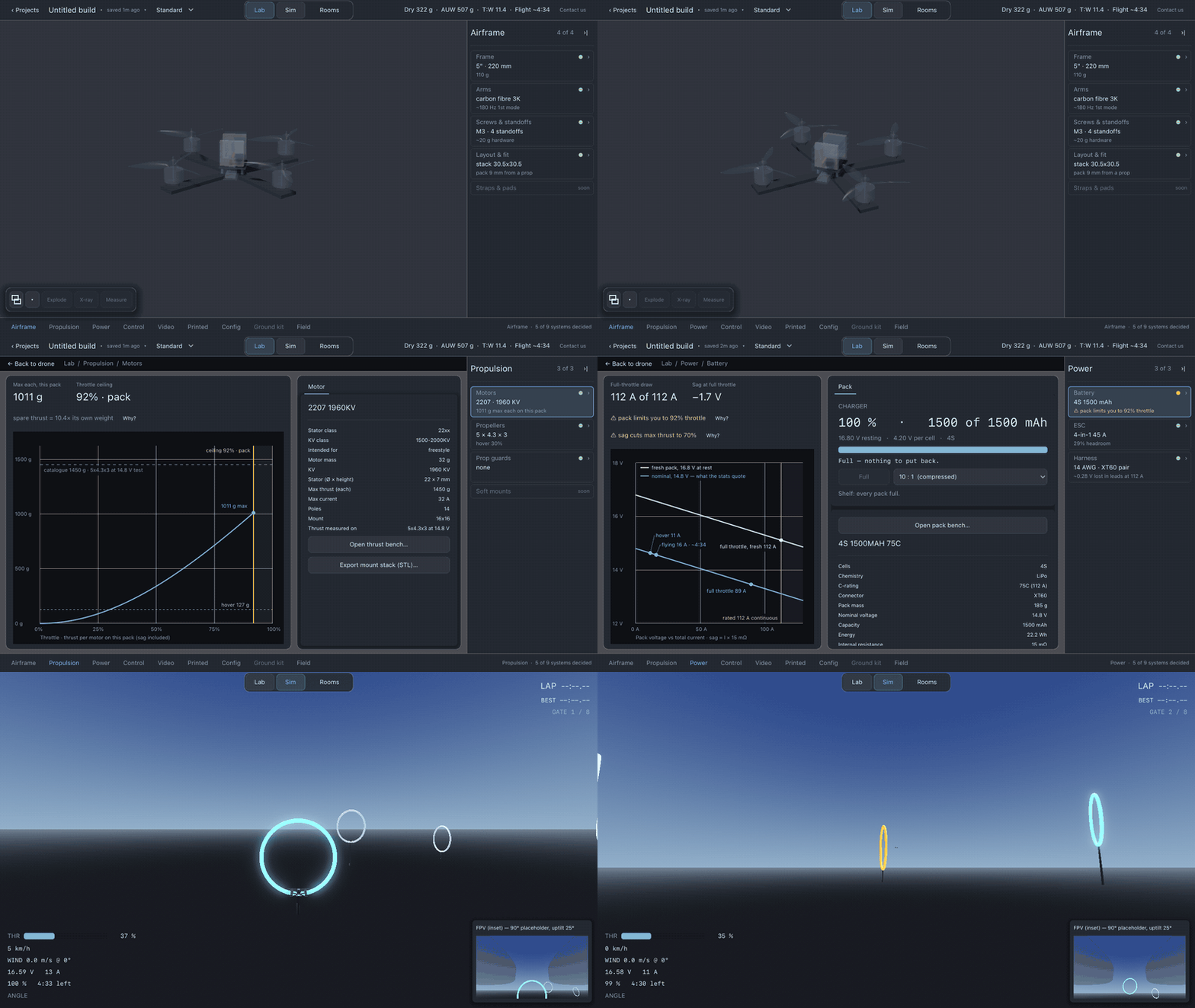
A drone design workbench and flight simulator. You put together an FPV quad from a catalog of real parts, and every choice changes the physics. Swap a 4S pack for a 6S one and you can watch thrust-to-weight, hover throttle and flight time recompute. Then you fly exactly what you built.
No stat is made up. Thrust comes from manufacturers’ measured tables, packs sag under load, and inertia depends on where each part sits on the frame.
see it fly
the nine sections
A build moves through nine sections, the way a real one does on the bench:
- Airframe — pick a frame, arms and fasteners. The frame is drawn to its real size, so it doubles as a fit check: put 7” props on a 3” frame and you’ll see them collide.
- Propulsion — motors and props. Look at the blade in 3D and see what it does to thrust.
- Power — the pack, the ESC and the harness between them. Every amp from the cell to the motor lead is accounted for.
- Control — the flight controller, the receiver link and the tune.
- Video — camera, VTX and antennas. The camera’s uptilt is the angle you fly at.
- Printed — the TPU parts your build needs, generated from the build itself.
- Config — motor direction, ports, failsafe and rates, plus a setup sheet to take to the real quad.
- Ground kit — the radio and goggles you fly with. Coming soon.
- Field — fly it through an eight-gate circuit. Your best lap is saved.
why it’s free
Lothal is for anyone who wants to learn how a drone really works before they spend money on one. It’s open source, so the physics can be checked, and parts are plain JSON files with a source for every number. If your motor isn’t in the catalog, add it and send a pull request.